Human Rights Project @ Bard
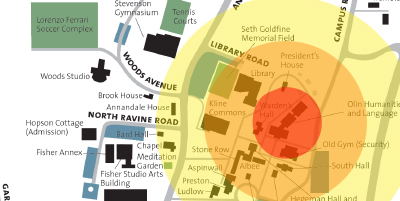
The Director will be speaking at Bard College as part of the Human Rights Project speaking series. Details are sketchy but expect something Tuesday, April 10 6pm 7pm in Olin 102.
Dirblogger

The Director has a blog. Stop the press.
Unmanaging
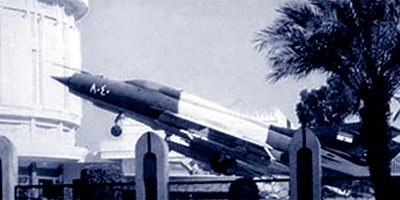
The Director has a brief article on new American technologies of war, and the ways they use images to make life and death decisions. It’s in the current issue of Bidoun, and titled “Networks of images, lives, and deaths.”
Ambient Addition in Rio De Janeiro

Opening March 19th, 2007, the FILE festival in Rio De Janeiro, Brazil, will include a special version of Noah Vawter’s Ambient Addition project. In this special incarnation, the project will be mounted inside a public bus, nicknamed Mavesonica, in order to present music synthesized from traffic noise to travelers.
Notorious in Libraries

To draw attention to the skyrocketing cost of academic and scientific journals from commercial publishers and the role that these costs play in limiting public and open access to (frequently publicly funded) scientific research, Benjamin Mako Hill and Annina Rüst did some social engineering in the MIT libraries as part of their overprice tags project. For the project, they went into libraries and put price tags on the one hundred journals that MIT pays more more than USD $5,000 a year for.
The project been blogged by the library and an interview with Mako was published! Who knew libraries blogged?
rock ‘n’ scroll on turbulence.org
Annina’s project rock ‘n’ scroll was blogged on turbulence.org.
Your Money or Your Rice
Annina’s eRice c00k3r appeared in the blog of mention, We Make Money Not Art.
King in the Land of the Blind

April 4, 1967
“We have destroyed their two most cherished institutions: the family and the village. We have destroyed their land and their crops. We have cooperated in the crushing of the nation’s only noncommunist revolutionary political force, the unified Buddhist Church. We have supported the enemies of the peasants of Saigon. We have corrupted their women and children and killed their men.
Now there is little left to build on, save bitterness. *Soon the only solid physical foundations remaining will be found at our military bases and in the concrete of the concentration camps we call “fortified hamlets.” The peasants may well wonder if we plan to build our new Vietnam on such grounds as these. Could we blame them for such thoughts? We must speak for them and raise the questions they cannot raise. These, too, are our brothers.
…
At this point I should make it clear that while I have tried in these last few minutes to give a voice to the voiceless in Vietnam and to understand the arguments of those who are called “enemy,” I am as deeply concerned about our own troops there as anything else. For it occurs to me that what we are submitting them to in Vietnam is not simply the brutalizing process that goes on in any war where armies face each other and seek to destroy. We are adding cynicism to the process of death, for they must know after a short period there that none of the things we claim to be fighting for are really involved. Before long they must know that their government has sent them into a struggle among Vietnamese, and the more sophisticated surely realize that we are on the side of the wealthy, and the secure, while we create a hell for the poor.
Somehow this madness must cease. We must stop now. I speak as a child of God and brother to the suffering poor of Vietnam. I speak for those whose land is being laid waste, whose homes are being destroyed, whose culture is being subverted. I speak for the poor of America who are paying the double price of smashed hopes at home, and death and corruption in Vietnam. I speak as a citizen of the world, for the world as it stands aghast at the path we have taken. I speak as one who loves America, to the leaders of our own nation: The great initiative in this war is ours; the initiative to stop it must be ours.
This is the message of the great Buddhist leaders of Vietnam. Recently one of them wrote these words, and I quote:
Each day the war goes on the hatred increases in the heart of the Vietnamese and in the hearts of those of humanitarian instinct. The Americans are forcing even their friends into becoming their enemies. It is curious that the Americans, who calculate so carefully on the possibilities of military victory, do not realize that in the process they are incurring deep psychological and political defeat. The image of America will never again be the image of revolution, freedom, and democracy, but the image of violence and militarism (unquote).
If we continue, there will be no doubt in my mind and in the mind of the world that we have no honorable intentions in Vietnam. If we do not stop our war against the people of Vietnam immediately, the world will be left with no other alternative than to see this as some horrible, clumsy, and deadly game we have decided to play. The world now demands a maturity of America that we may not be able to achieve. It demands that we admit that we have been wrong from the beginning of our adventure in Vietnam, that we have been detrimental to the life of the Vietnamese people. The situation is one in which we must be ready to turn sharply from our present ways. In order to atone for our sins and errors in Vietnam, we should take the initiative in bringing a halt to this tragic war.”
h/t Americablog. Full speech here.
Sensorium: Robotics and Control
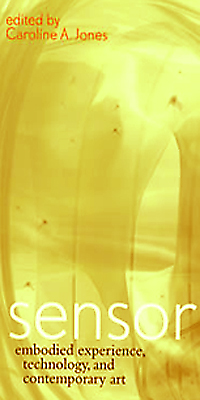
The List Visual Arts Center at MIT, an excellent art space and long time friend of CCG, has been hosting an exhibition titled Sensorium, the first part of a series. The catalog, edited by the inimitable and brilliant Caroline Jones, has just been released on MIT Press, and the Director was deeply honored to contribute entries on robotics and control.
All the sounds that’s fit to print

Shifty is in the New York Times with his Ambient Addition project.
 Computing Culture Group